2027 Kia EV3 Reviews, Pricing & Specs
Write a review--
Original MSRP
7
of 10
expert review
avg user rating
(0 reviews)
Pros
Good range with bigger battery
Well-equipped in all but base trim
Good power with AWD
Cons
Base battery is light on range
Harsh reaction to road dips
Modest FWD power

The 2027 Kia EV3 is here to crystallize the brand’s entry-level EV strategy.
While Kia did this before with the Niro EV, that model offered less maximum range, cost more, and used a platform shared with gas, hybrid, and plug-in hybrid models. Now the EV3 rides a dedicated EV platform, offers up to 321 miles of range, and carves out a spot as the second-lowest-priced EV on the market.
Verdict: In all, the EV3 is a worthy entry-level electric vehicle. It doesn’t compete well with the Chevrolet Bolt and Nissan Leaf in its base level, but higher trims have the range and features to make it a compelling pick for EV shoppers on a budget.
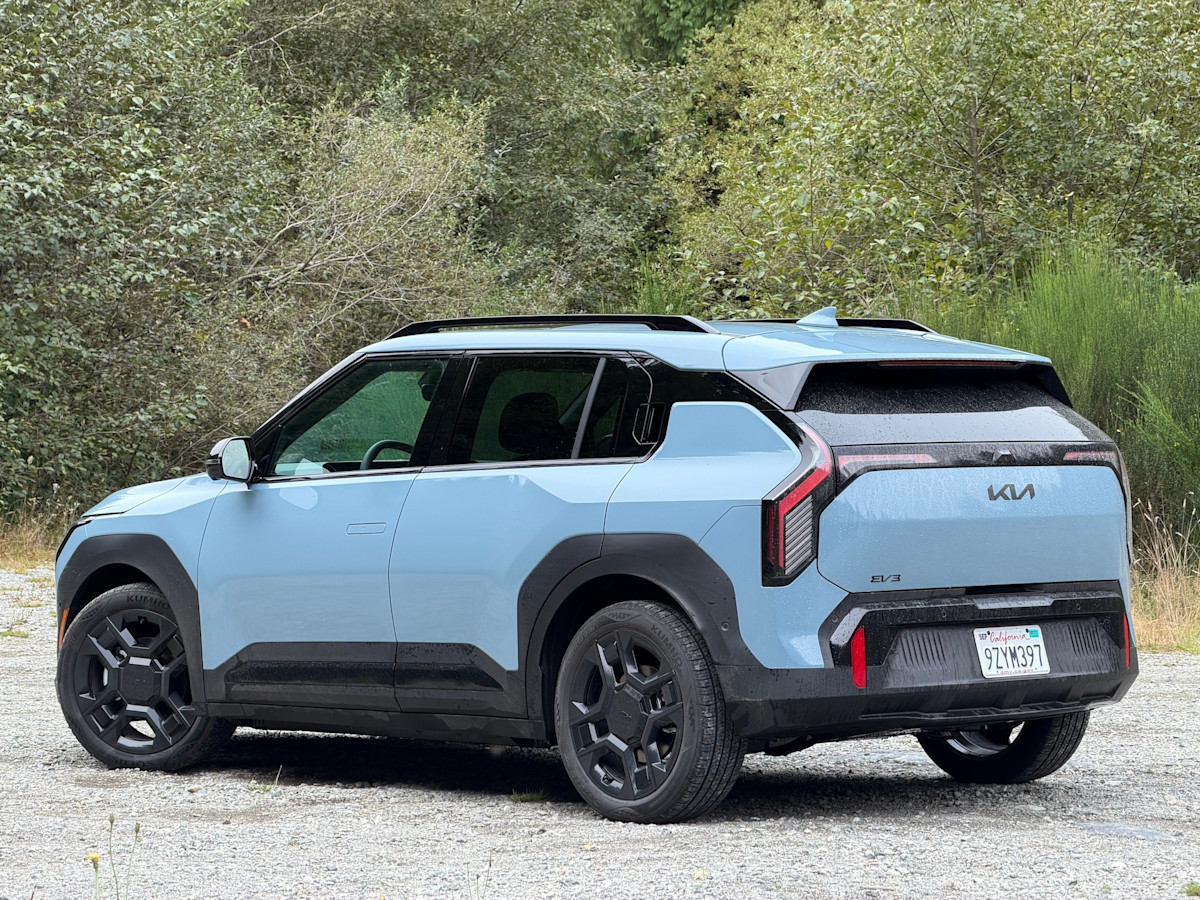
The EV3 isn’t particularly attractive, but it’s not offensive, either. It’s 15.5 inches shorter than the EV6 and 1.2 inches taller, and it has an upright, more squared-off look. The lines adhere to Kia’s Opposites United design language that contrasts shapes found in nature with those of the human and industrial world.
The nose features very little grille area with large daytime running lights at the corners in the shape of stylized upside-down Vs. Vertical LED headlights are integrated with the DRLs, a hood line connects the DRLs, and a frowning lower line leads into a small, low-set grille. The flanks sport a combination of rounded shapes with squared-off and creased lines. Black cladding surrounds the wheels and covers the rocker panels, as well as a concave character line above the rockers. The 17- or 19-inch alloy wheels are pushed to the corners, giving the EV3 the shortest overhangs in the brand’s lineup. The rear end has a built-in spoiler, drooping LED taillights, and a swath of dark trim down low.
Four-spoke-design wheels give the EV3 a static look, but the EV3 does a good job of cheating the wind. A full underbody cover and active air flaps contribute to a slippery 0.275 coefficient of drag.
A Nightfall package blackens the exterior trim, 19-inch wheels, roof rails, and emblems. Inside, it gives the EV3 a dark gray and black interior.
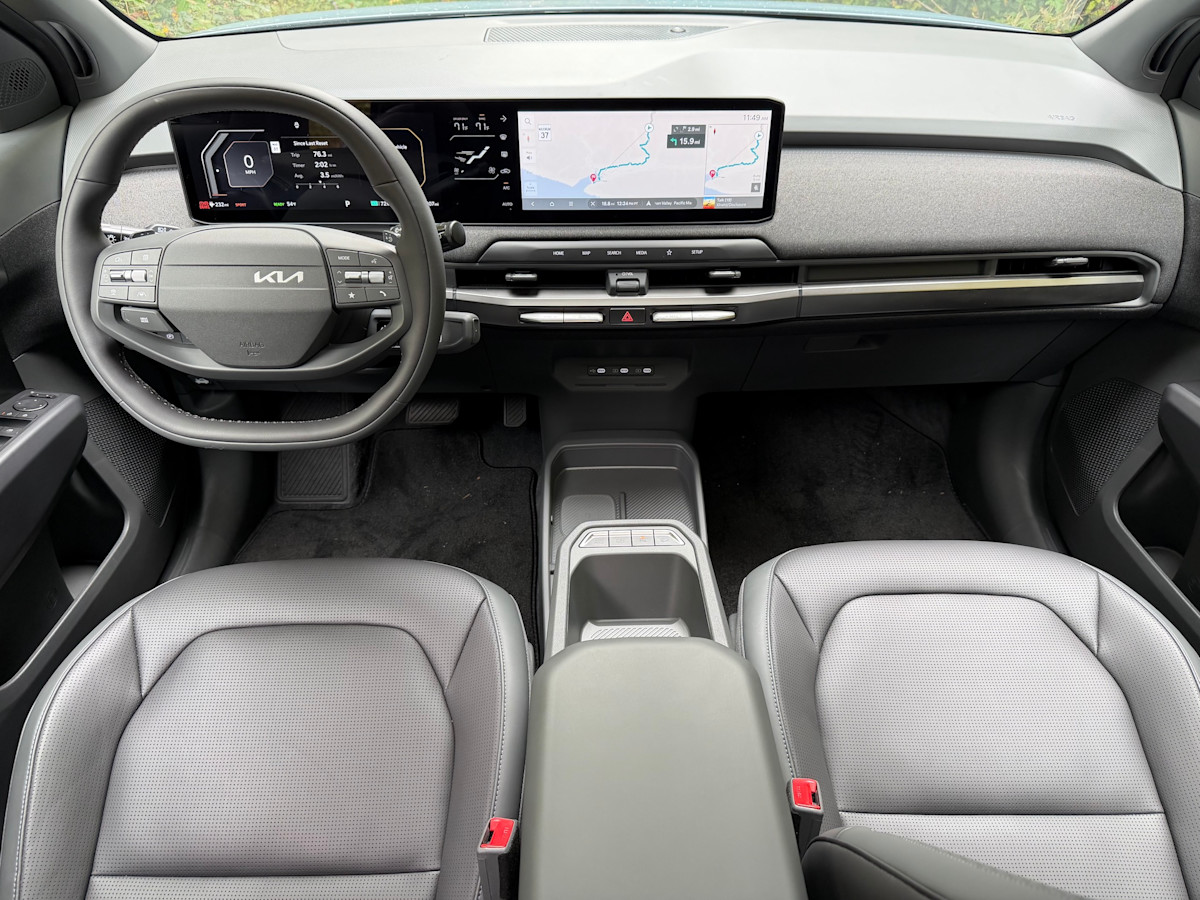
The interior has a simple, horizontal layout, highlighted by the 30-inch bank of screens. Cloth upholstery comes standard in the base Light trim, and the other models get standard synthetic leather. The GT-Line has a two-tone off-white and gray color scheme, and the GT has gray synthetic leather and synthetic suede upholstery with neon green accents.
The interior materials are appropriate for the EV3’s entry-level price point, yet they feel fairly substantial. There are quite a few hard plastics, but they have fine fit and finish. A cloth swath on the dash provides a nice bit of contrast without adding too much cost for Kia.
The EV3 is offered with front- or all-wheel drive, two batteries, and three power levels. In its base Light trim, it has a 58.3-kWh battery with a single front motor good for 201 horsepower and 209 pound-feet of torque. The step-up Wind trim swaps in an 81.4-kWh battery while keeping the same power level. Opting for AWD adds a second motor at the rear to up the output to 261 hp and 284 lb-ft. The GT trim also has AWD and makes 288 hp and 345 lb-ft.
We drove the 201-hp FWD Land and 261-hp AWD GT-Line trims. While FWD models have modest power, it’s perfectly adequate for everyday driving. The EV3 doesn’t push you back into your seat at launch, but the immediate torque of the electric motor helps it get out ahead of traffic and post a 0-60 mph time of a quoted 7.5 seconds, which feels right. Power is more readily available at lower speeds, so passing power is only modest.
The addition of an extra motor provides some welcome additional thrust. Our AWD GT-Line model was noticeably stronger from a stop and during passing maneuvers. Kia quotes a seemingly appropriate 6.5-second 0–60 mph sprint.
While we didn’t drive it, Kia says the GT model cuts the 0-60 mph sprint to 5.4 seconds. It also gets firmer suspension tuning, which might be a deal breaker. More on that shortly. Kia offers four levels of brake regeneration via its iPedal system. Triggered by steering wheel paddles, it varies from freewheeling to close to one-pedal driving. Drivers will decide for themselves what setting they prefer, but it’s good to have the choice.
In general, the EV3 drives well. It offers the quiet cruising of an electric vehicle without excessive wind or road noise. The steering has some good heft to make it stable mid-corner, and the low-set battery and short 105.5-inch wheelbase make it fairly agile. Its all-season tires and 4,048–4,453-pound curb weight mean it isn’t truly sporty, though.
The suspension absorbs most bumps well, but the short wheelbase, excess heft for its size, and some odd damper tuning create a real problem over ruts and dips. In these instances, the suspension compresses, then shoots the body back up, disrupting passenger comfort and sometimes upsetting vehicle balance. When we hit a dip in a corner it caused the EV3 to alter its course slightly. We weren’t going particularly fast in that instance, but it caused us to slow down on a winding coastal road for fear that another dip could send us heading off the road. Kia needs to do some work on the rebound properties of the EV3’s dampers.
The EV3 has a small footprint but good space for its size. Front seat occupants have plenty of space in the EV3, with standard manual adjustments. Ten-way power driver’s seat adjustments and heated front seats are standard on the Wind and up, and the GT-Line and GT get a 10-way power front passenger seat. Standard dual-zone automatic climate control aids comfort front and rear, and front comfort can be further aided by available ventilated seats and a heated steering wheel.
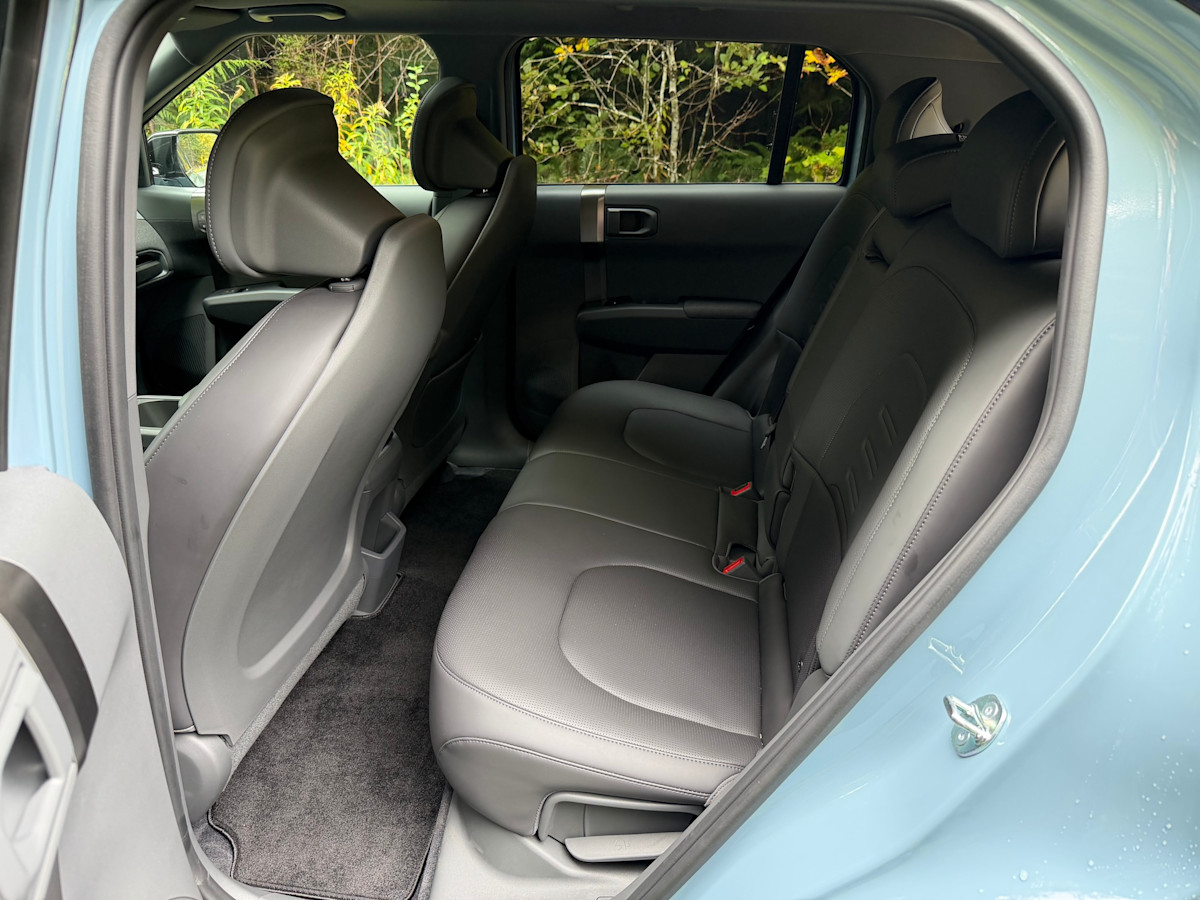
The second row also offers good space for a vehicle of this size. Our 6-foot-4-inch co-driver was able to fit behind his own front seating position, though with his knees brushing up against the front seat back. Fitting three adults across in the back will be a stretch, but two back there will usually be comfortable.
There’s good small-items space, too. The center console has open and closed elements to provide easy access to phones, keys, change, etc. It’s a two-tier console with room for a purse in the rubberized lower level, but the top tray isn’t rubberized, so items can slide around and fall out.
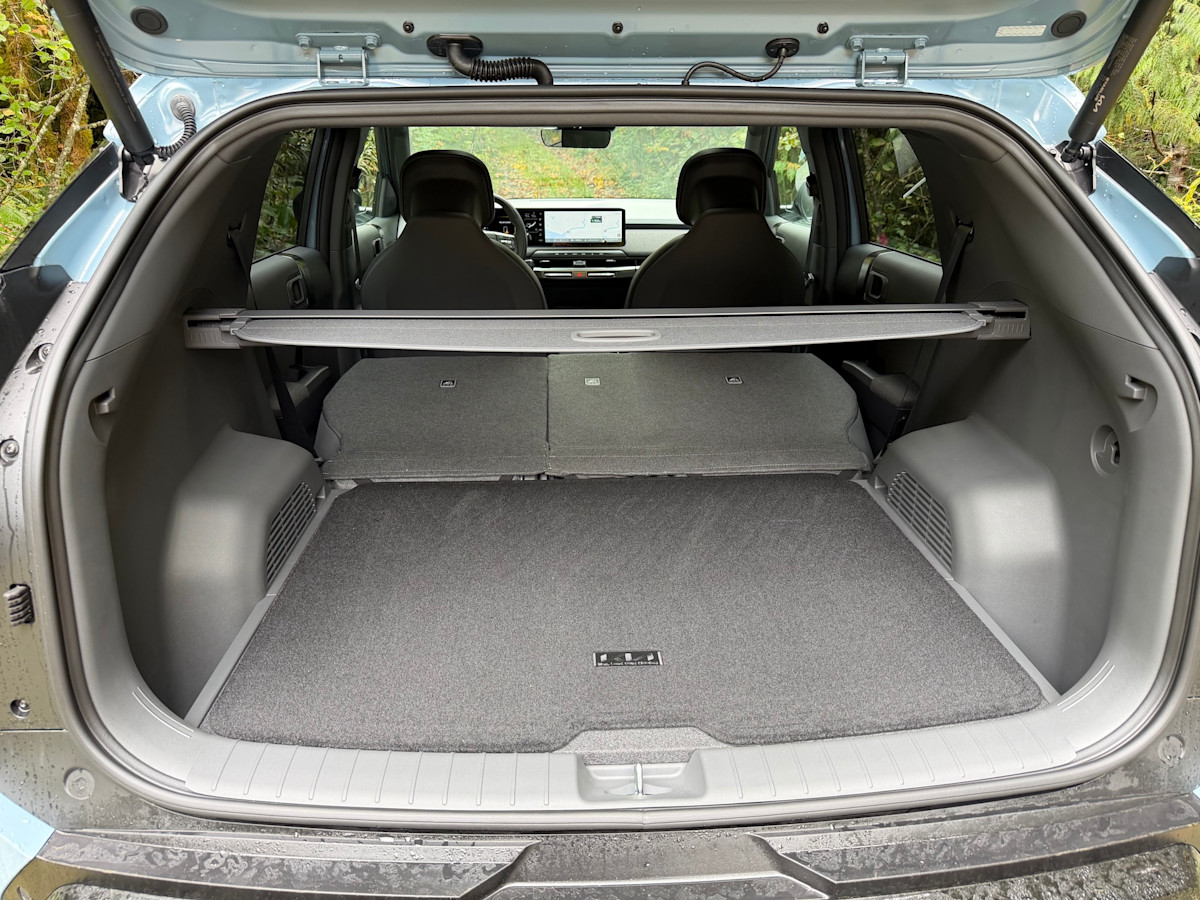
Cargo space is excellent for the size. The EV3 has 26.1 cubic feet of cargo space behind the rear seats, and that expands to 56.5 cubic feet with the rear seats folded down. It also has a small 0.9-cubic-foot front trunk. In all, that’s more space than the typical subcompact crossover, mostly due to the upright design.
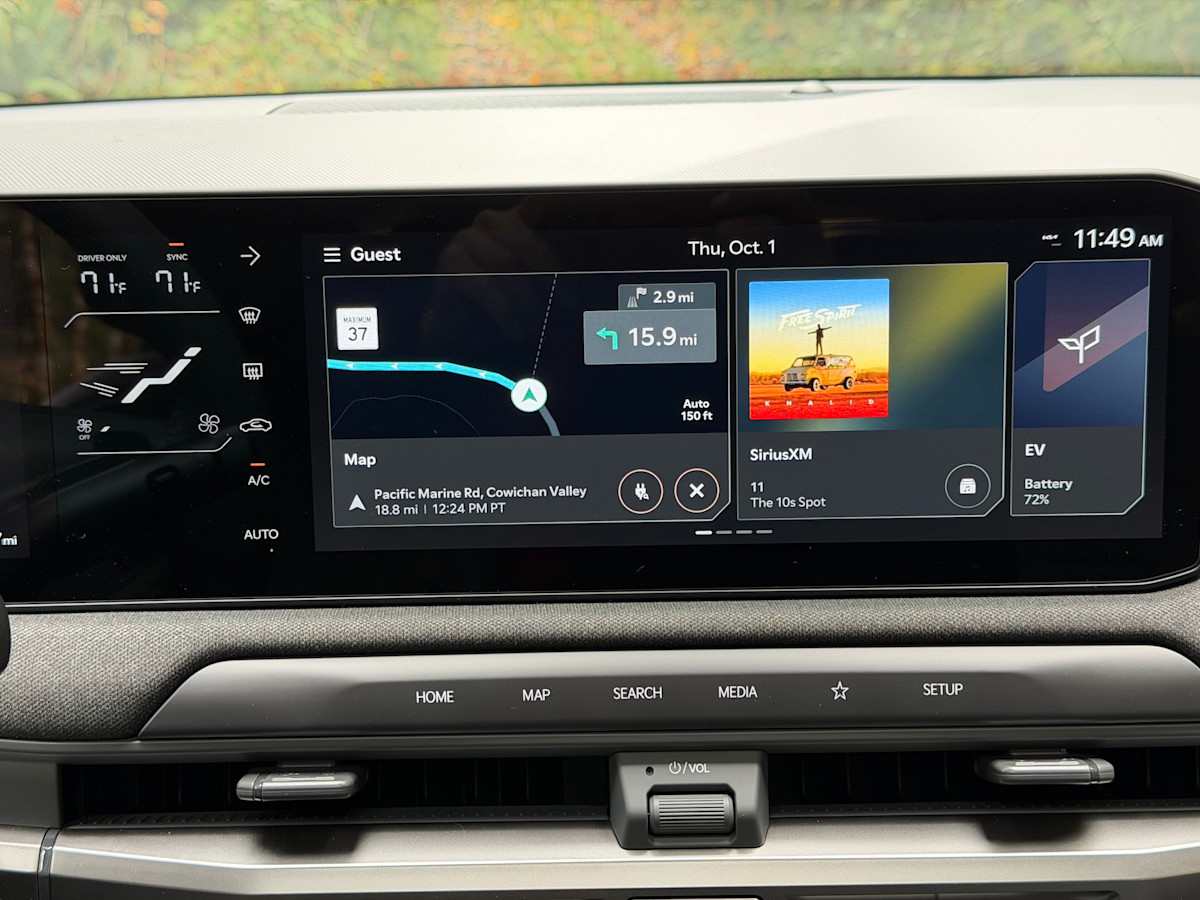
The EV3 has an abundance of screen space. It gets dual 12.3-inch screens, one a digital instrument cluster and another an infotainment touchscreen, plus a 5-inch climate-control touchscreen that sits between them, and it all sits under one piece of glass.
The infotainment touchscreen allows for video streaming through Netflix and YouTube when parked, and it can display several themes, including Marvel, Star Wars, Disney, Pixar, and all 30 NBA teams. A voice-activated AI assistant comes standard, and buyers get a three-month trial of Kia myQ Connected Garage that allows drivers to control their garage doors through the touchscreen.
Also standard are wireless Apple CarPlay and Android Auto, cloud-based navigation, satellite radio, and a six-speaker audio system. The infotainment system also offers music streaming, and a wireless smartphone charger comes on all but the base trim. Buyers can also get a head-up display, a digital key, and an eight-speaker Harman Kardon audio system.
The infotainment system is easy to use. The driver can scroll through the screen to access various icons, and touch controls below the screen provide quick access to the home, map, media, search, and setup screens. There is also a star hard key that provides a shortcut to frequently used controls.
The 2027 Kia EV3 comes standard with forward-collision warning with intersection assist, automatic emergency braking, blind-spot monitors, rear cross-traffic alert, lane-keep assist, adaptive cruise control, rear occupant alert, a driver-attention monitor, a safe-exit warning system, and automatic high beams. The Land trim and above get front, rear, and side parking sensors, rear automatic emergency braking, a blind-spot view monitor, a surround-view camera system, and Highway Driving Assist that combines adaptive cruise control with lane-keep assist.
The GT gets enhanced automatic emergency braking with oncoming vehicle alert and steering support during passing maneuvers, steering support for the blind-spot monitors, evasive steering assist, remote automatic parking, and Highway Driving Assist 2 that can initiate lane changes.
That’s a lot of standard and available driver-assistance features for an entry-level SUV. All of the systems worked well during our initial drive, but we didn’t put many of them to the test. We will require more time behind the wheel to get a true picture of all the systems, though these systems work well in other Kias, so we expect similar results. We are particularly fond of the blind-spot view monitor as it really helps the driver place the car within its surroundings.
As a new vehicle, the EV3 has not yet been crash tested by either the National Highway Traffic Safety Administration (NHTSA) or the Insurance Institute for Highway Safety (IIHS).
The EV3 is the second most affordable EV on the market, with a starting price of $31,385, including a mandatory $1,495 destination fee. However, its value doesn't really shine through at that price point, offering only 221 miles of range from its 58.3-kWh battery pack compared to 262 miles for the Chevrolet Bolt, 303 miles for the base Nissan Leaf, and even 253 miles for the outgoing Niro EV it replaces.
The much better choice is the step-up Wind trim that adds the larger 81.4-kWh battery and increases the range to 321 miles for a price of $36,485. From there, the Land trim runs $39,985, the GT-Line costs $44,985, and the GT will set you back $47,385. AWD adds power, reduces range to 280 miles, and costs $3,700 on the Wind and Land; front-wheel drive is standard on the Light, and AWD is standard on the GT-Line and GT.
The big-battery, front-drive models are the most efficient, with EPA ratings of 131 MPGe city, 104 highway, and 117 combined compared to 115 MPGe combined for the base Light and 103 MPGe combined for the AWD models. Those numbers compare to 120 MPGe combined for the Bolt and 121 MPGe combined for the Leaf. We saw 3.6 mi/kWh in the FWD Land over 95 miles and 3.5 mi/kWh over 65 miles in the GT-Line. Both are rather efficient results, especially given sometimes enthusiastic driving.
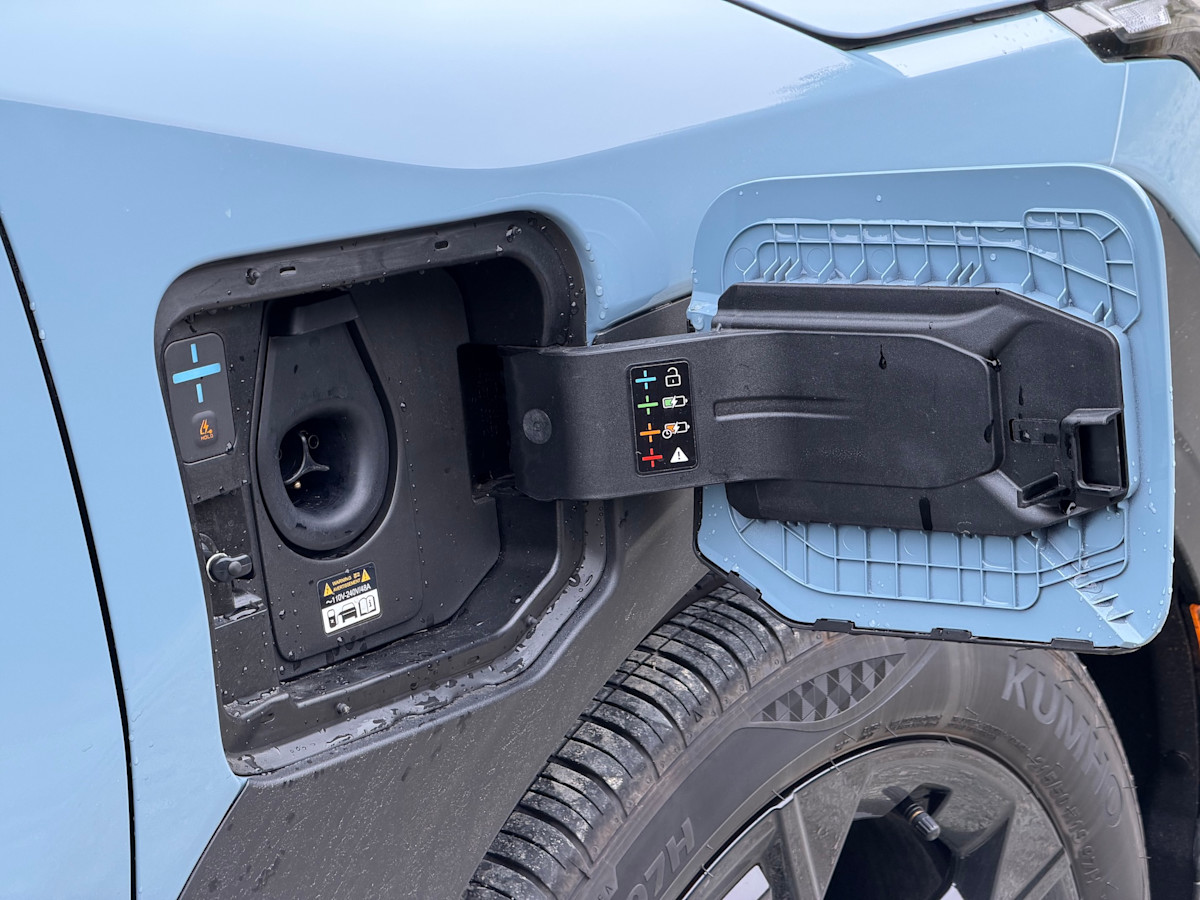
The EV3 uses a 400-volt electrical architecture that doesn’t charge as quickly as the EV6’s 800-volt architecture. Still, it can charge from 10%-80% in 29 minutes with the base battery and 31 minutes with the big battery on a 350-kW DC fast charger at a maximum rate of 127 kW. It comes standard with a NACS charging port that works on Tesla Superchargers. A standard 11.2-kW onboard charger allows it to charge in 5 hours and 10 minutes with the base battery and 7 hours with the bigger battery on a Level 2 home outlet. The GT-Line and GT trims also offer vehicle-to-load bidirectional charging, so the battery can charge e-bikes, laptops, and small appliances. Add a Wallbox home charger and it can send power back to the home during a blackout.
In all, the EV3 surpasses the Niro EV thanks to more range, more power, and more space due to its dedicated EV platform. It may not be the cheapest EV on the market, but it’s close enough and it is well equipped and incredibly practical.


